The Story of Morse Code: Dots, Dashes, and a Legacy of Communication
onzlabs
July 10, 2024
4 min read
Explore the fascinating history of Morse Code, its invention, its pivotal role in communication, and some intriguing facts about this iconic system.
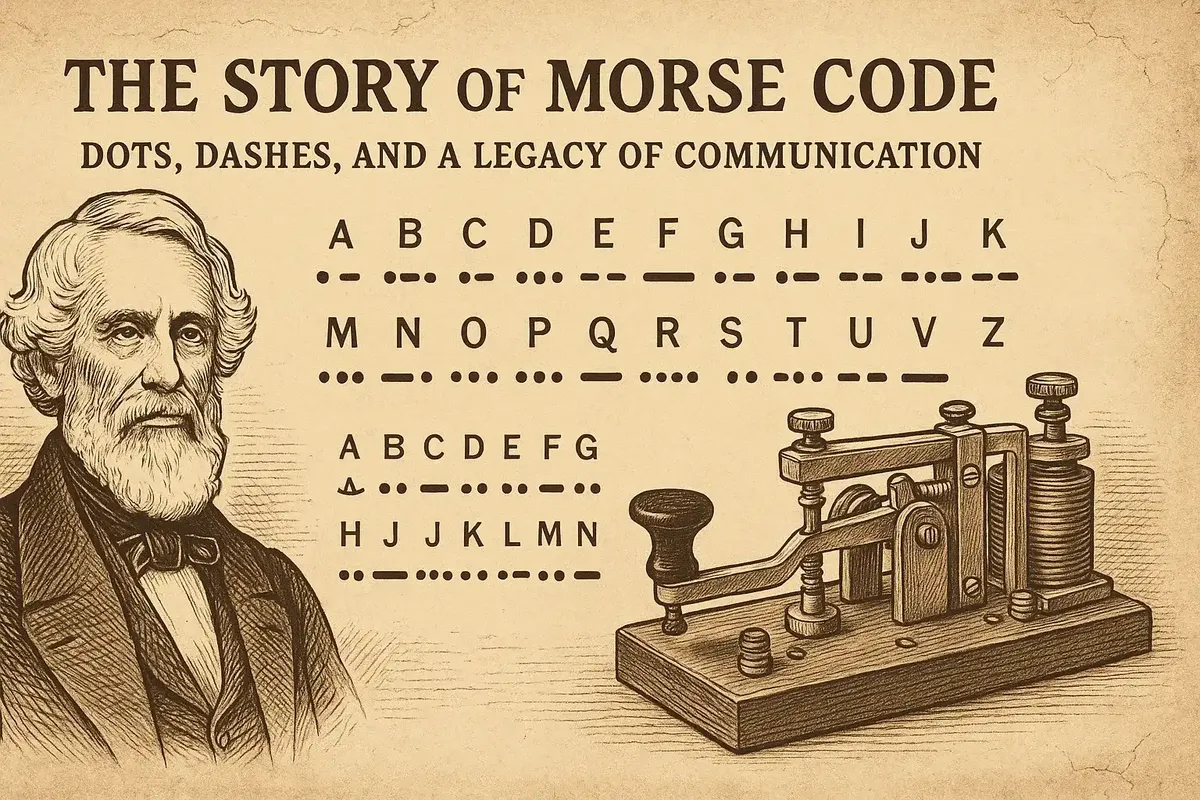
In an age of instant messages, video calls, and global connectivity, it's easy to forget the revolutionary communication methods that paved the way. Among them, Morse Code stands out as a testament to human ingenuity, a system of dots and dashes that once spanned continents and oceans, carrying vital information across vast distances.
What is Morse Code?
At its core, Morse Code is a method of transmitting text information as a series of on-off tones, lights, or clicks that can be directly understood by a skilled listener or observer without special equipment. It's essentially a binary code, representing letters, numbers, and punctuation marks through short signals (dots or "dits") and long signals (dashes or "dahs"). The duration of a dash is three times the duration of a dot. Each dot or dash is followed by a short silence, and letters within a word are separated by a silence equal to three dots. Words are separated by a silence equal to seven dots.
Who Discovered It?
The invention of Morse Code is primarily credited to Samuel F. B. Morse, an American painter and inventor. While he is often solely associated with its creation, it's important to acknowledge the significant contributions of his assistant, Alfred Vail. Vail played a crucial role in developing the code itself, refining it into the more efficient system we recognize today. Morse focused more on the telegraph apparatus, while Vail worked on the coding scheme. The first public demonstration of the telegraph using Morse Code occurred in 1837, and the first official telegraph message, "What hath God wrought," was sent by Morse on May 24, 1844, from Washington D.C. to Baltimore.
Why Was It Used?
Morse Code became indispensable for several reasons:
- Simplicity and Efficiency: It allowed for the transmission of complex messages over long distances using simple electrical pulses. Early telegraph systems were limited in their ability to transmit voice, making a coded system essential.
- Reliability: In an era before robust radio and telephone networks, telegraph lines were often the most reliable form of long-distance communication, especially for critical information.
- Speed (for its time): While slow by today's standards, a skilled telegrapher could transmit messages much faster than a messenger on horseback or by ship.
- Global Reach: It facilitated rapid communication across continents and oceans, playing a vital role in commerce, journalism, and military operations.
The Decline and Enduring Legacy
With the advent of more advanced communication technologies like the telephone, radio, and eventually the internet, the widespread commercial use of Morse Code began to decline in the mid-20th century. However, it continued to be used by amateur radio operators, in aviation (for navigational beacons), and by the military for specialized purposes.
Interestingly, the international distress signal SOS (···---···), which is easily recognizable in Morse Code, remains universally understood and is still taught in some maritime and aviation contexts.
Easter Eggs and Fun Facts:
- The Titanic's Last Calls: Morse Code played a tragic but crucial role in the Titanic disaster of 1912, as its distress calls were sent via wireless telegraphy.
- The First "Text Message": Some consider the first telegraph message, "What hath God wrought," to be the precursor to modern text messaging.
- Amateur Radio: Morse Code remains a popular mode of communication among amateur radio enthusiasts (hams) worldwide, valued for its efficiency in challenging signal conditions.
- "CQD" vs. "SOS": Before SOS became the international standard, the British Marconi Company used "CQD" as their distress signal. The Titanic initially sent CQD before switching to the newer SOS.
- The "Morse Code" Sound: The distinctive "dit-dah" sound of Morse Code has become iconic and is often used in movies and media to signify urgent or coded communication.
The legacy of Morse Code extends beyond its practical applications. It represents a pivotal moment in the history of communication, demonstrating how a simple, elegant system can overcome technological limitations and connect people across vast distances. Even today, its influence can be felt in the digital world, where binary codes continue to underpin our most advanced technologies.
Want to try your hand at Morse Code? Check out our Morse Code Generator and Morse Code Decryptor tools!